

ALLEN WHEELER is a creative living in the sunny Southwest. He is a composer, multi-instrumentalist, songwriter, singer, and writer of memoir, poetry, and short stories. He earns his living as a technology manager. He enjoys construction projects, building science fiction models, drawing, photography, and abstract art.
ANGELA: When did you start playing?
ALLEN: I started playing the organ (two keyboards, foot pedals, anyone younger than 50 know what I’m talking about?) when I was 7 or 8 years old, then piano at 11. I guess I started playing around with the guitar at 13 or so. Started writing on piano at 13-14 years old Didn’t start composing on guitar till college, cowrote incidental and interlude music for a stage show with another guitarist. That was the first time I played with another musician, I loved the interplay of our guitars on that show and the interplay of performing with another.
ANGELA: What drew you to playing music?
ALLEN: I’m not really sure, to tell you the truth. My dad for some reason had an interest in the organ, maybe inspired by the Lawrence Welk show which was often watched in the house, or perhaps just his interest in the electronics of it. But I was immediately drawn to the full sound, the band-like impact, of being able to play two different keyboards with very different characteristics and add in a third instrument with the bass pedals. I’d grown up around relatives that played guitar, and I always thought that a single person playing a single guitar, while interesting, was limited. I was very much a loner in many ways and didn’t see myself playing in a band at that time, but here I could be an entire band by myself. Playing the organ is the one thing that made me understand song arrangement.
ANGELA: Who is one of your favorite musicians? And why?
ALLEN: Iva Davies, an Australian, who had a band called Icehouse. Listening to him filled out my understanding of arrangement, the tones he would use in different ranges, nothing overpowering anything else in its musical space, while incorporating complexity into each instrument. He would get the most interesting and musically useful sounds out of the Fairlight synthesizer, which took true technical and musical genius. His writing evolved as he did. He’s probably been my biggest influence as a composer and as an arranger. Michael Hedges also comes to mind, no one (and I truly mean no one) performs on a guitar like him. He has imitators, there are others that approach his style, but he is THE master – both hands doing the most unexpected things! The writing on Aerial Boundaries in particular is intensely unexpected while intensely flowing – massively innovative – weaving constantly with his playing. Davies is my greatest influence; Hedges is an inspiration I will never catch up to.
ANGELA: What type of music are you listening to at present?
ALLEN: I’ll always be stuck on pop and rock from the 80s. I know very little popular music produced after say 2000, probably just a generational thing, but I don’t get engaged in auto-tune voices or the variations of rap. Oh, an exception would be rave culture and trance, some shoegazer stuff. I don’t follow any particular band in these genres, but I’ve a few playlists with Claude Challe, Loop Guru, Transglobal Underground. Some of the post-modern stuff can be interesting, I was blown away by Collective Soul in the 90s, and Extreme – a lot of technical virtuosity, some nice fierce guitars, a kind of wry observation of life showing up in songs like “December” and “Peacemaker Die” – these two bands in particular maintain a certain musicality, commitment to the elements of writing and performing and, again, arranging, that draws me to music.
ANGELA: What instruments do you play?
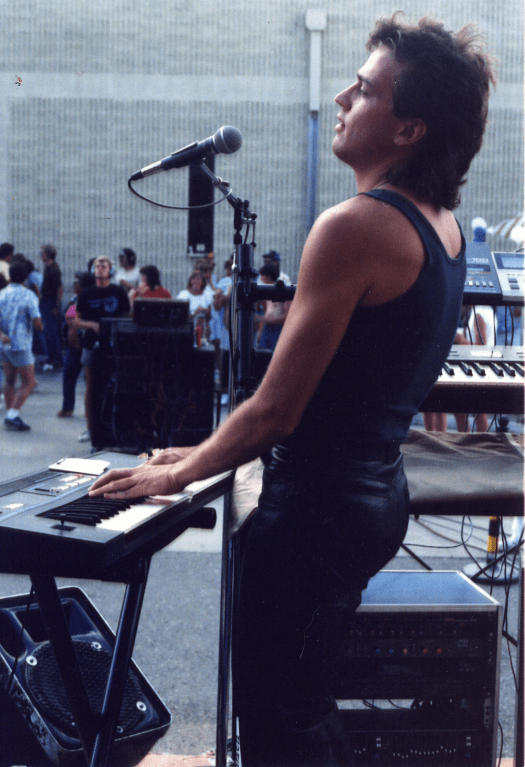
ALLEN: Generically, keyboards and guitars – specifically, today I use a decent velocity-sensitive keyboard from Casio of all companies, using MIDI to trigger other synthesizer modules; for guitars, I’ve got a nice orange label Yamaha and a Strat knockoff. Most of my recording is in GarageBand, which is about as complicated as I want to get while giving both good recording characteristics and a good selection of guitar effects when I don’t want to go through all the effects boxes. A few other knockabout instruments, which still get used for specific sounds in recording.
ANGELA: What genres and styles of music do you play?
ALLEN: Some pretty varied categories. Heavy rock, synth pop, acoustic singer-songwriter, piano solo. The instrument in my hands will allow the expression of a different genre – composing on guitar will give a rock or an acoustic piece, a keyboard will allow the expression of a piano piece or what will become a synth-based number. As the song takes form, the high points of additional instruments make themselves known, and that influences how the final song will be recorded.
ANGELA: What draws you to those genres/styles?
ALLEN: I’m not really drawn to one or another, not in those terms. What wants to be expressed is the starting point, and the work flows towards a genre. I think that’s why I don’t limit myself to one style, because all of the things that become uncovered in my process are not the same style. The style serves the work, rather than the work serving a style. I think the fine tuning of the particular sounds and arranging are paying more attention to style, as the work matures it becomes more structured and gets fitted more cleanly into the details of the genre. I start thinking about the work in terms of presentation after the song has made itself known, and it kinda matures into what the audience might expect from one genre versus another. At that point, I’m creating a song that I would like to listen to myself.
ANGELA: Have you had any formal training or education?
ALLEN: I took lessons from a few organ teachers, got the technique of this instrument and the basics of musicianship and music theory. After that, about 5 years of classical piano. A few guitar classes, in middle school and college, as well as private instruction.
ANGELA: Do you feel the lessons were beneficial?
ALLEN: Yeah, musical instruction is a two-edged sword to a certain extent. You can get a lot of the mechanics of a keyboard, or more specifically a piano-forte, from a teacher, learn technique that might not have occurred to you; at the same time, it can also be limited; with the guitar, there’s a heckuva lot of technique needed to properly pay classical guitar – a lot of required form, a lot of bad habits to practice out of – that, if you adhere to, you cannot become a Michael Hedges who’s technique is so far out of the box that no classical guitarist would dream of creating or performing, material that is haunting, complex, beautiful. The practice that formal training demands made me a better keyboardist, while I intentionally ignore much of what I was taught about playing guitar in favor of creating a personal style and sound. I guess learn the rules and know when to ignore them.
ANGELA: How frequently do you play?
ALLEN: I go through phases of daily playing (particularly when composing or recording) to years of not touching an instrument. Sometimes life says “Go focus your time and energy over there,” and other times the cusp of creation demands attention and it is time to sit at the edge of the well and transport what comes out into the music. I’m entering an active phase, got my studio set up again, got my guitars on their stands and out in the living room. The last few years have been reflective and listening to past recordings, to a degree making friends with my creativity again after riding this wild tiger called life.
ANGELA: Where do you practice and how do you prepare for a gig?
ALLEN: A lot of the technical practice and writing is the living room, then as it gets closer to recording I switch to the studio and start using the particular instruments that will go into the final song – practice the parts with the intended guitar or intended synth patch, get into the nuance of that particular instrument, adjust the style of the playing, get the notes right, and then listen to what’s evolved. I haven’t played live in years, since the late 80s, when I was working in a few bands (cover bands, an experimental jazz outfit, and an outlet for my compositions) and the occasional wedding (please may I never hear Rod Stewart’s “You’re In My Heart” ever again).
ANGELA: How do you play (alone, band, orchestra, etc.) and in what types of venues?
ALLEN: At this stage of life, I spend weekdays at my day job (IT management) and strength training, and weekends have a lot of construction projects. Focus on my mom and time with my pal (who has written the poetry that forms the basis of a lot of my music) is important, especially at my life stage of reaching retirement age. That kinda limits music to odd slices of the clock, and my consciousness is a timeshared computer system: music gets the off-hours rates when others are not online. Early morning gym time also cuts out late night gigs. If my life were different, I’d be practicing and playing in the evenings.
ANGELA: Where can we listen to your music?
ALLEN: My YouTube channel. There’s some odds and ends, but most songs are in album playlists. The latest is the track It’s You (2025 Remix).
ANGELA: Do you compose or arrange music? What types?
ALLEN: Covered above, pretty much. I see myself as first a writer, then an arranger, and lastly as a performer.
ANGELA: What other creative activities are you involved in?
ALLEN: In the sense of manifesting something new into the world, I build and remodel – I’ve put up a 1600 square foot shop with an attached office, remade homes with new external doors and exteriors, added porches and patios starting with welded steel frameworks. I’ve been termed a master modeler for my science fiction and automotive model work. I’m working on a 3 foot-plus edition of the Seaview from Voyage to the Bottom of the Sea (lots of putty and sanding) and a kit of the Interceptor V8 from Mad Max. I do pencil portraiture and have dabbled in watercolor, photography was a passion for a while, have a series of abstracts created with computer art applications. Of course, lots of prose and poetry that did not evolve into lyrics.
ANGELA: What do you know now that you wish you had known when you were starting out?
ALLEN: Not a thing, at least not about my creative process. I’m well-satisfied with my evolution as a creative. Knowing anything has not been a cornerstone of my work, understanding and enhancing my process has meant the world – that process could not have developed in any other way or at any other pace.
ANGELA: What is one piece of advice you would offer to someone who is new to the music world?
ALLEN: Find what it is in music that you are passionate about – writing, performing, presenting, reviewing, producing, whatever it is. Do all of it to the extent you can, to understand it, and once you find that magic current that you connect with, resonate with, feel the sense of “the eternal yes” about, do that. Do it for you, do it for others, do it for free and hone that skill. If you feel there is nothing else you want to do, you will have established your competence, confidence, and reputation, preparing you to do this professionally…and if you choose a different day job career, never stop doing it for yourself.
ANGELA: What do you do about creative burnout?
ALLEN: Rest. If drinking in the clouds of creation is at your center (and, believe me, it is there in all of us), you will relax and the door will open again.
Connecting and keeping up with Allen Wheeler
YouTube
Facebook
Interview conducted in October 2025.
 Night Sky Coaching