
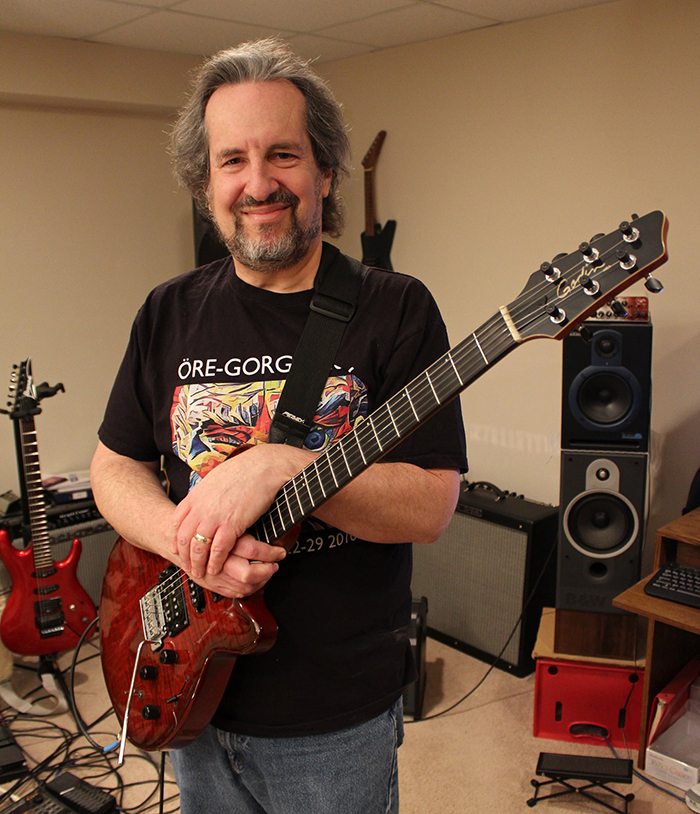
ALAN BENJAMIN is a multi-instrumentalist and composer who specializes in the intricate genre of progressive rock music. He is also a music educator and audio engineer as well as the production manager/technical director for the long-running NJ Proghouse live concert/festival series and a founding member of the internationally acclaimed prog band, Advent.
ANGELA: When did you start playing? And why?
ALAN: I started playing music at a very young age and, as a result, it may actually be most practical if I address my inspiration for starting up front. My dear mother (who passed away in late 2018) was a very accomplished pianist and songwriter. Between hearing her play piano on what I believe was generally a daily basis and all the records spinning on my parents’ stereo, music was always a dominant presence in my life.
My mom was very fond of recalling how I “begged” for piano lessons at age two but that she felt it best to wait until I turned three to start. When the time came, she hired a great piano teacher named Paul Sargent who quickly got me up to speed on the basics and I recall doing quite well in this regard (in spite of the fact that I’m sure it must have been impossible for me to reach the pedals until I was a bit older). I also started playing around with my dad’s old f-hole Vega acoustic guitar a bit when I was pretty young, learning basic chords from songbooks he had laying around.
As a result of being a somewhat difficult and challenging child, I was essentially kicked out of the private school I’d attended and my mom took advantage of the opportunity to place me in a new (private) school that was known for having the best school orchestra in all of New York City. Shortly after starting, the orchestra’s conductor had me come down and listen to a rehearsal with the idea that I would pick a new instrument on which to learn and participate. I was deeply moved by the cello passages of a particular Telemann piece that afternoon and was very close to choosing cello as a result, but decided to go with violin at the last minute. Fortunately, this turned out to be a great choice and I became a bit of a prodigy, quickly advancing in the orchestra and also performing a bit of small ensemble work.
During my time at this particular school, I also learned to play soprano recorder (a requirement for everyone in my grade) and briefly took flute and snare drum lessons as well. Eventually asked to leave this school too, I ended up joining a city youth orchestra where I was placed in the second chair of the first violin section. My penchant for challenging authority eventually resulted in being kicked out of this third school as well, this time with my being sent away to a boarding school for troubled children in the Main Line area (west of Philadelphia). For some reason that was never disclosed, I wasn’t allowed to bring my violin but quickly got into rock music and ended up switching to guitar as a primary instrument just a few months later.
ANGELA: Who is one of your favorite musicians? And why?
ALAN: Being rather infatuated with composition, my instinct is to highlight one of my favorite composers here: the late, great Pekka Pohjola. Hailing from Finland, Pekka’s primary instrument was bass (and he played piano and violin as well), though his magical compositions are what really drew me in and left such a large imprint on my own musical psyche. While Pekka initially played with a great early Finnish progressive-rock band called Wigwam, in the early 1970s, his wonderful discography of solo releases are among my all-time favorites.
It’s hard to describe why I love Pekka’s music so much, but a lot is probably tied to its emotional impact. Some of the key elements that I often find present include intriguing harmonic structures (in a particular style that you don’t hear much outside of the Nordic region, though I can sometimes hear a tangential relationship in certain compositions by Thijs van Leer from the Dutch band Focus), lengthy melodic statements, subtle details, and sometimes a bit of humor as well.
ANGELA: What type of music are you listening to at present?
ALAN: Though still very much a fan of progressive-oriented music, I’ve migrated quite a bit away from most newer “prog rock” on the whole and am generally most excited by releases that wouldn’t fall directly in that category for the most part. Some of the contemporary artists whose music I’ve most recently been enjoying include Gabriel Kahane and Rasmus Dahl. Both would be rather difficult to pin down stylistically but I’d say Gabriel’s music often lies somewhere between (intricate) singer/songwriter material and modern classical—with Rasmus’s offerings crossing genres from progressive rock, (primarily Nordic) folk, and classical.
There are also several other fairly new releases that I go back to on a fairly regular basis, spanning a rather wide variety of genres. Some highlights include As the Waters Cover the Sea by Umpfel (prog-metal), Snacks EP by ART the Band (jazz-rock fusion), Thank You For Singing To Me by Bobbing (progressive indie, for lack of a better description), and the 27 Chords and a Bunch of Lies EP by Very Good Friends (Cardiacs-inspired punk-prog-pop). All in all, I’d have to say that this is all a rather eccentric mix, but I find all of these quite wonderful.
ALAN: What instruments do you play?
ALAN: Guitar is still my primary instrument and I still play piano/keyboards, violin, recorder, and (a little) flute. Additionally, I initially experimented with mandolin back in high school and have gone back to it quite a bit more intensely over the past few years. I picked up the bass in my later teens as well—and am particularly fond of playing the Rickenbacker 4001 fretless that I bought (used) in Philly back in the late 1980s. I’ve also been playing Chapman Stick for 30 years now and also try my best to do at least a passable job on the drums.

ANGELA: What genres and styles of music do you play? What draws you to those genres/styles?
ALAN: I’m a progressive rock musician at heart, so that’s generally where my sensibilities are centered. One of the things I love most about the (prog) genre, though, is that it’s the most open and flexible in regard to influence from any and all other genres—so, by definition, its scope has the potential to literally be all-encompassing.
ANGELA: Have you had any formal training or education? Do you feel it was beneficial?
ALAN: In addition to my early instrumental education, I learned a bit about music theory toward the end of high school. I also spent a semester at the Berklee College of Music the following fall (at age 16) and picked up quite a bit more in that short time. From there, most of what I learned was predominantly on the experiential side—though I did take guitar lessons from an amazing jazz-rock fusion player named Glenn Alexander for about a year or so about 10 years after leaving Berklee. Forming Advent with the incredibly gifted composer/keyboardist Henry Ptak (right around the time I stopped studying with Glenn) also turned out to be a vastly educational experience in regard to the development of my musical knowledge and instrumental technique.
I found all of this education and experience extremely valuable, especially in regard to refining my understanding of music. Over the past decade or so, I’ve also taken quite a few online courses that relate to music theory and/or instrumental development and am always looking for additional opportunities to improve my expertise in these realms.
ANGELA: How frequently do you play?
ALAN: I generally play at least one instrument every day. My primary focus at this point is on developing and recording new material—both with Advent and for my upcoming debut solo album—so the majority of my daily musical efforts tend to be guided by whatever project(s) I’m working on at the time. Also, while on a short break at the moment, I look forward to resuming my teaching work in the near future (primarily on guitar and Stick as of late).
ANGELA: Where do you practice and how do you prepare for a gig?
ALAN: The majority of my practice takes place in my home studio, though I often play acoustic instruments in other parts of the house as well. Though I’ve read sheet music for nearly 60 years now, I’m no longer very good at sightreading so I spend quite a bit of prep time—for both stage and recording—learning and internalizing my parts. This also helps to develop the corresponding muscle memory that facilitates a more subconscious and (hopefully) musical performance when the time comes.
ANGELA: How do you play (alone, band, orchestra, etc.) and in what types of venues?
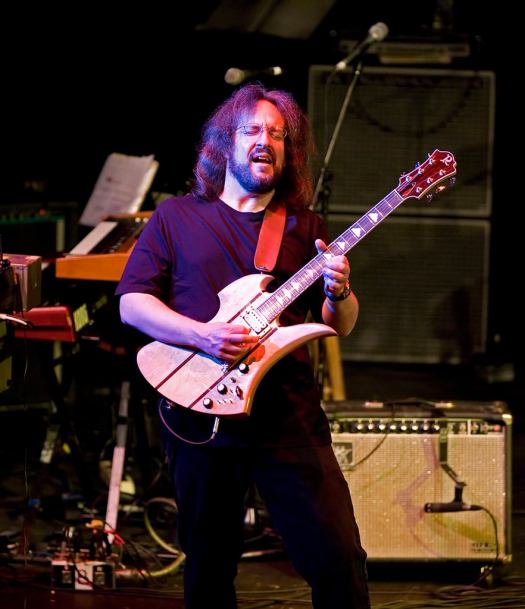
ALAN: Though I used to play with orchestras (and the occasional small string ensemble) as a child, virtually all of my performances as an adult have been with bands. After playing out in Philly-based FM top-40 cover band, Merlin, in 1981-1982, I took a fairly long break from the stage. Though I did play a couple of gigs with a New Jersey-based hard rock band called Riff Raff in 1989, my real return to playing live came when I joined the reformed incarnation of an extremely well-respected local prog band from the 1970s called Mirthrandir. I joined them in 2005, very shortly before Advent’s second album, Cantus Firmus, was released. Mirthrandir’s gigs ran from 2006-2009, with Advent starting live performances in 2007 as well.
Both bands sitting rather firmly in the progressive rock niche, most of our gigs (for both bands) were either at prog festivals or concerts that cater to this kind of audience. The corresponding venues ranged from clubs to concert halls and outdoor stages.
ANGELA: Where can we listen to your music?
ALAN: Thanks for asking. The best place to stream Advent’s music is on our website. Our music can be streamed here, directly from Bandcamp, and there are also links for our Spotify and Apple Music profiles at the bottom of the page as well.
Additionally, my debut solo single (where I play all the instruments) can be heard on Bandcamp.
On the video front, the majority of what I have (both with Advent and otherwise) can be found on my personal YouTube page.
There are also three Advent-related clips on the band’s (much newer) YouTube channel.
ANGELA: Do you compose or arrange music? What types?
ALAN: Yes, I both compose and arrange—often in a fairly integrated fashion. I started writing songs when I was about 14 or so, mostly for my high-school power trio (Amber). At that point, it was pretty much all hard rock with the occasional progressive edge. A couple of years later, though, my compositional approach started leaning a lot more toward progressive rock and has mostly remained that way. As the years went by, the scope of what I’ve written has become both wider and deeper—especially after forming Advent, given what I’ve learned from working with both (cofounder) Henry Ptak and his very talented brother, Mark, who joined the group about half a year after we started it.
For my upcoming solo album, I’ve already got 10 compositions in the works (with seven of these tracks already recorded and mostly mixed as well). While close to half are approached as virtual band pieces with corresponding arrangements, there are several miniatures that are either solo performances or duets—and one recorder quartet as well. Though I think there are some elements of prog in these latter pieces, I’d say some of them might seem closer to a variant of classical music in some respects.
ANGELA: What other creative activities are you involved in?
ALAN: On the musical front, I’ve become rather invested in developing my audio mastering skills over the past five years or so and am approaching two years of doing this work for others on a professional basis. (Prior to that time, I remastered several of Advent’s older tracks and also worked on live recordings from the NJ Proghouse concert/festival series that I’ve helped to run since 2009.) I also very much enjoy teaching music and have had a number of wonderful students—on guitar, bass, and Chapman Stick—over the past few years. On the non-musical front, I’ve always enjoyed photography as well.
ANGELA: What do you know now that you wish you had known when you were starting out?
ALAN: As a musician, I’d say understanding the value of listening and being able to really understand what you’re hearing and playing (as opposed to simply focusing on the technical side of physical execution). This also goes for performing in an ensemble context, though particularly in regard to locking in with everyone else you’re playing with. Even when I’m overdubbing in the studio—whether in a band context or when laying down tracks on my own solo recordings—the more I can listen to everything else, the better I feel I perform. (I think this also helps the subconscious kick in a bit more and do its magic.)
Though I began studying music theory in my teens, I wish I’d had a better appreciation for developing these skills early on. While solfege really turned me off to ear training, while at Berklee (again, being just 16 at the time), I’ve really developed an appreciation for the benefits of training one’s ear in particular.
ANGELA: You’ve mentioned twice about the subconscious mind and its effect on the music you play. Could you explain how that works?
ALAN: From a personal standpoint, I don’t find my conscious mind to be very creative—and I find that the most compelling ideas come when I can allow my subconscious to communicate what it wants. Most of my writing and arranging is done on-instrument and the sparks typically fly at their peak when I can distract myself enough to let ideas flow instinctively. Being a type-A personality with a very active mind, this often means getting into a zone where I’m at least a bit distracted so that there is room for the ideas to flow from below (so to speak). Analysis and adaptation of these ideas generally occur on a conscious level, but the initial inspiration almost always seems to come from somewhere underneath.
A similar thing happens on the performance level as well, though that’s more about balancing the subconscious and conscious efforts involved. (I don’t think any instrumentalist can fully function without at least some level of conscious control.) To a great extent, the less I concentrate on my own physical execution and just listen, the better I play. It’s an odd dynamic to put into words, but it’s something I notice on a reasonably consistent basis.
ANGELA: What is one piece of advice you would offer to someone who is new to the music world?
ALAN: Follow your passion and make music that you truly love. It’s always been difficult to make a living as a musician—and, in many ways, it’s harder than ever these days—but I recommend satisfying your own musical desires to the best of your ability above all else. Contrary to popular opinion, I also think you’re more likely to be discovered and obtain at least some level of commercial success if your true musical identity really shines through in what you do.
ANGELA: What do you do about creative burnout?
ALAN: Though it may seem counterintuitive, I find discipline to be the best way to get past moments of creative burnout. For me, setting specific goals and deadlines provide a foundation for forcing myself to keep working and, once I get past a particularly tough spot, it’s often quite surprising how quickly things start falling back into place afterward and the momentum picks up naturally.
Connecting and keeping up with Alan Benjamin:
Alan’s blog
Alan’s Facebook page
Alan’s YouTube channel
Advent website
Advent on Bandcamp
Advent on Facebook
Advent’s YouTube channel
Interview Conducted October 2025.
 Night Sky Coaching